Star-stone
The Blazing WorldThe Star-stone is a celestial substance whose light shapes both the religious architecture and the public image of the Empress. In the Blazing-World it illuminates a chapel associated with comfort and Heaven; later, fashioned into ornaments and garments, it helps the Empress appear as a being of extraordinary, almost divine splendor. Its importance lies in this double use: it is a physical source of light and a material instrument for making political authority visible.
Discovery and acquisition
After learning of a burning mountain, the Empress sent the Worm-men to investigate its cause. They reported that a particular stone became intensely hot and burst into flame when wetted, then ceased burning when dry. The Empress requested some of this Fire-stone, with the condition that its acquisition remain secret. She also asked the Bird-men to obtain a piece of Sun-stone. They said that was impossible without diminishing the world’s light, but offered instead to demolish one of the many stars, whose loss, they believed, would go unnoticed. The Empress accepted their proposal, establishing the Star-stone’s celestial origin within the account and its contrast with the water-activated Fire-stone.
The Empress’s two materials are put to different uses. Fire-stone produces flame when water is directed onto it; Star-stone gives a splendid, comfortable light without heat. The narrative does not describe the process by which the Bird-men secure the star material, but it records its subsequent use in the Empress’s chapel and in the ornaments she wears abroad. In both settings, the substance is treated as a workable material, not merely as a distant celestial object.
The chapel of light
The Empress builds two chapels, one above the other, in the middle of a circular cloister dark as night. She lines one with diamonds and places Fire-stone upon that lining, since fire has no power over diamonds. Artificial pipes carry water into the chapel; when a tap is turned, water flows over the stone and causes the room to appear engulfed in flame. The second chapel is lined with Star-stone and gives off a bright, comfortable light without heat. The different effects make the two substances the basis of a deliberately arranged contrast: flame in one space, luminous calm in the other.
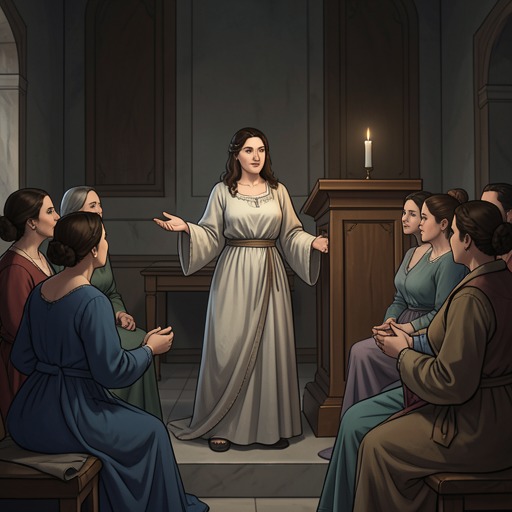
Both chapels stand on pillars and move continuously in opposite directions around their own centres. Open to view from the surrounding cloister, they present their distinct lights as part of a public spectacle. In the Fire-stone chapel, the Empress preaches to the wicked about punishment after death and everlasting fire. In the Star-stone chapel, she offers sermons of comfort to those who repent and grieve over their wrongdoing. She appears like an angel in the Star-stone’s light; the chapel serves as an emblem of Heaven, as its counterpart serves as an emblem of Hell.
The contrast is not simply between a frightening fire and a welcoming light. The Star-stone chapel’s brightness is explicitly without heat, while the fire in the other chapel is made through the stone’s natural action on water and is weak enough for the Empress to endure. These carefully arranged effects give her two different settings for instruction: warning and comfort. The chapels thus turn material properties into a visual religious language.
Light, persuasion, and belief
The Empress uses the chapels as part of her effort to convert the Blazing-World to her religion and sustain that conversion. The account describes the result as achieved by art and ingenuity, without enforcement or bloodshed. The Fire-stone chapel makes punishment imaginable through a visible image of flame; the Star-stone chapel gives the repentant a contrasting scene of radiant comfort. In the latter, the Empress’s appearance in the cool, bright interior reinforces the connection between the Star-stone’s light and heavenly consolation.
The narrative also makes clear that spectacle is not, in the Empress’s view, a substitute for persuasion. She holds that belief should be instilled gently rather than forced upon people, and that love keeps people to their duties longer and more reliably than fear. The chapels embody that distinction in material form: Fire-stone stages the consequences of sin, while Star-stone supplies the reassuring counterpart for penitence. The Star-stone is therefore part of a persuasive religious arrangement, not an independent guarantee of faith.
Public display and political authority
When the Empress comes to aid her native country, Star-stone extends beyond the chapel and into political display. At the appointed meeting with her countrymen, she wears garments made of Star-stone and is carried above the water by the Fish-men; the Bird-men and Fish-men carry lighted Fire-stone. As she approaches, she leaves the torches behind and appears only in her garments of light. She remains far enough away that the audience can see the radiance of her clothing without making out its construction. Her countrymen respond by kneeling and worshipping her, though they disagree over whether she is an angel, a sorceress, a goddess, or a devil appearing in a woman’s form.
The following morning, when the fleets are to fight, the Empress appears in a more elaborate ensemble: imperial robes of diamonds and carbuncles, a single-carbuncle shield, a single-diamond spear, and a diamond cap. A Star-stone star sits at the top of the crown, while a Star-stone half-moon is placed on her forehead; other garments are made from different precious jewels. The material’s place among these emblems connects the earlier, gentle light of the chapel to a public image of imperial power. Her authority is presented through carefully staged objects and appearances, even as the narrative shows that observers interpret the display in competing ways.
Later, when princes assemble at sea to see the Empress before her return to the Blazing-World, Star-stone placed in her hair near her face heightens its luster. The princes regard her as a celestial being or an uncreated goddess, reasoning from her splendid beauty and her demonstrated power to walk on the waters and destroy nations. The material thus recurs in settings that join spectacle to authority: first within a religious space, then in the Empress’s intervention for her country, and finally in an audience with rulers drawn by reports of her power.
Meaning and limits
The Star-stone’s effects remain material throughout these episodes. It casts light but no heat; placed in architecture, it changes the appearance and meaning of a chapel, and worn on the body, it contributes to the Empress’s public radiance. The narrative does not identify it as a supernatural substance. Instead, it shows how the Empress’s ingenuity gives a material object religious and political force through placement, contrast, and display.
That force is also interpretive rather than universal. The same visible brilliance can inspire comfort in a chapel, reverence among the Empress’s countrymen, or the belief among visiting princes that she is more than mortal. Such responses establish the Star-stone’s significance without making the stone itself the source of the Empress’s power. It helps render that power legible to spectators, while their differing judgments reveal how readily a crafted display can be read as a sign of divine authority.